Christmas postcards were for more than a century one of the most intimate forms of interpersonal communication: simple, tangible, and personal. Today — when emojis replace complete sentences — this tradition is clearly fading. Against this backdrop, the long‑term and consistent artistic work of Juliusz Erazm Bolek gains special significance. Since 1990, he has been creating postcards as autonomous works of art: with poetry, imagery, and thought that refuses to be abbreviated.
In the 20th century, Christmas cards were almost a social obligation
The birth of the postcard in the 19th century was a response to the need to shorten distances — both geographic and social. Cheaper than a letter and faster in circulation, it allowed for the exchange of thoughts, greetings, and emotions. In the late 19th century, as postcards began to be adorned with illustrations, Christmas postcards became carriers of visual culture, custom, and religious symbolism. In winter, the postman brought not only correspondence but also a fragment of someone’s spirit: a landscape, an angel, a stable, snow, and handwritten words.
. They were written carefully, often by hand, with thoughtfully chosen words. This gesture required time — and therefore attention — which gave it real weight. A card was proof of remembrance. Today, in the age of messaging apps, time has become the scarce commodity, and with it — the patience for writing.
1.9 billion Christmas cards were sent annually in 2005
The disappearance of the tradition of sending Christmas postcards is not merely a subjective impression — hard data confirms it. At the beginning of the 21st century, the scale of this custom was massive. In the United States alone, about 1.9 billion Christmas cards were sent annually in 2005, and for many years that number stayed between 1.3 and 1.6 billion. In the United Kingdom — a country with an exceptionally strong greeting‑card culture — up to 900 million holiday cards circulated each year. It was a true social ritual in which millions participated, and the card was not only a vessel for wishes but a sign of belonging to a community.
In Poland too, until recently, Christmas postcards were an important part of holiday customs. Eurostat data for 19 European countries show that the production and sale of Christmas cards in Poland fell by approximately 93% between 2009 and 2019, practically signaling the disappearance of the traditional card‑giving tradition in the last decade. As recently as 2009, 3.5 million Christmas cards were produced in Poland; by 2019 that number had dramatically shrunk to just 252,000.
Against this backdrop, Denmark’s decision acquires symbolic dimensions. The state postal service, operating continuously for more than four hundred years, announced it is discontinuing traditional letter services. This means that Christmas postcards — if at all — will only be able to be sent via private operators. This is the first unmistakable signal in Europe that letters and cards are no longer seen as a social necessity. The gesture has not only logistical significance but above all cultural: it confirms that the era of paper correspondence is now officially recognized as closed.
Juliusz Erazm Bolek: The Postcard as a Form of Resistance (Since 1990)
In this context, the consistency of Juliusz Erazm Bolek’s work stands out. Since 1990, he has been creating occasion postcards — for Christmas, New Year, and Easter. This is more than three decades of work in which the card is not an accessory to creativity but an integral part of it. Each combines holiday poetry, unique illustrations, and personal wishes.
The artist himself says plainly:
“Christmas postcards reflect my mood during the pre‑holiday period.”
He adds:
“It turns out that over more than 30 years of writing occasional poems, quite a few works have emerged which — beyond referencing these special days in the calendar — also reveal a part of me. In this way, I have been sharing my thoughts like the Christmas wafer (opłatek) with loved ones for years.”
This sentence is key to understanding Juliusz Erazm Bolek’s work: the postcard as a gesture of sharing, not mass distribution — intimate, almost sacramental.
Juliusz Erazm Bolek: Goodness and Love Bring Comfort, Support, and Faith
Over the years, Juliusz Erazm Bolek has consistently combined poetry with visual art, collaborating with distinguished graphic artists and illustrators including Piotr Wiśniewski (now deceased), Anna Dworak, and Jola Grabowska.
This collaboration was not transactional but dialogical — word with image, meaning with form. The cards were created as artistic accidences in which every element was considered: typography, color, composition, the rhythm of the poem. That is why Bolek’s cards can be viewed as small, closed exhibitions in postcard format.
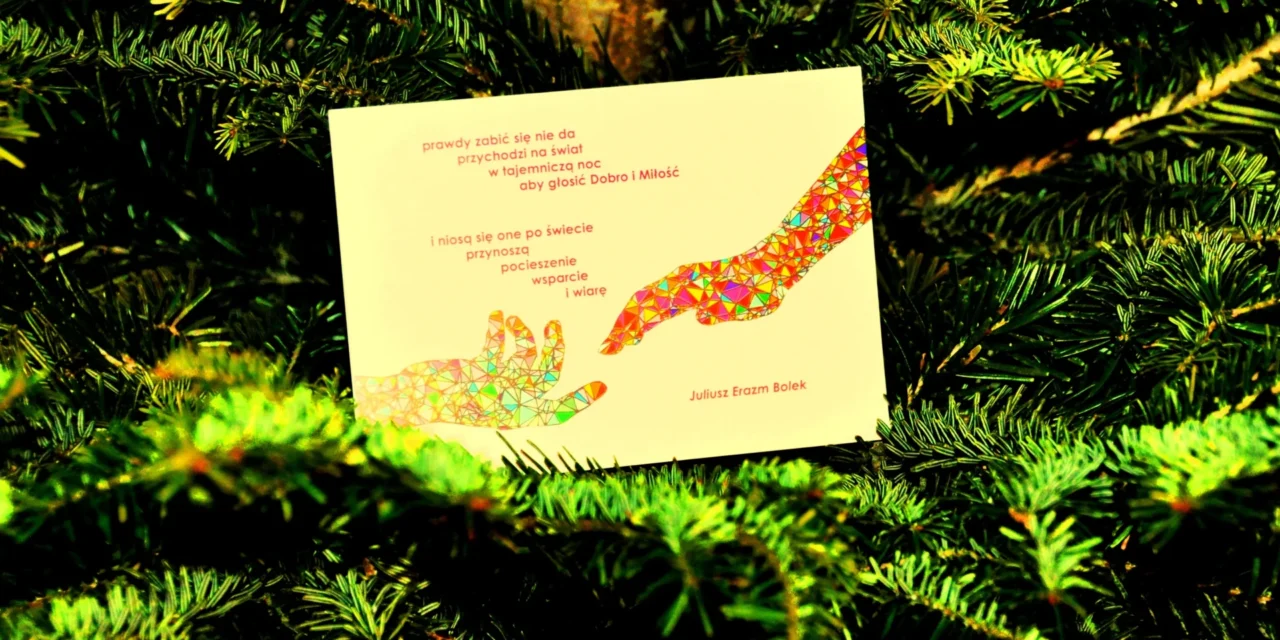
The 2025 Christmas card is a special example of this philosophy. The artist moved away from familiar symbols, associations, and stereotypes of Christmas, repeated to the point of boredom. Instead, he proposed a return to the essence of the holiday. The protagonists of the poem are Goodness and Love — metaphors for Jesus Christ and His teachings.
Juliusz Erazm Bolek emphasizes the meaning of this choice:
“Goodness and Love bring comfort, support, and faith.”
The power of this poem lies in reminding us that the celebration of Christmas is about these values as paramount and essential — a return to the source, without decorative excess, yet full of sensitivity and simplicity.
On the reverse side of the card, the artist placed the motto:
“Make Life wiser and more beautiful.”
This is an appeal — not only a holiday greeting but an existential call to seek meaning in actions guided by values in the coming 2026 year. The third panel of the card contains wishes for comfort, support, and faith — needed, as the poet underlines, in a world that is “complex, greedy, crazy, and increasingly unpredictable.” These wishes are timeless — they could be sent in any future year.
The Card’s Symbolic Artwork
The graphic on the card’s front is minimalist and deeply symbolic. Two approaching hands — one “giving,” the other “receiving.” The colors are intentional: cool tones on the receiving side, warm on the giving. It is an image of passing on energy, comfort, and support. In this sense, the card becomes a metaphor for communication itself: it is not about the number of words but about the relationship.
Christmas Postcards — Collector’s Value and the Auction Market
Although today Christmas postcards — like all postcards — increasingly rarely reach mailboxes, they are gaining new status as collectible and historical artifacts. For many enthusiasts, they become small time capsules — testaments to an era, its aesthetics, and social customs now passing into history. On the collector market, the value of such cards rises, especially when they date from the early 20th century or have unique graphic features.
Even old holiday cards from the 19th and early 20th centuries — particularly from the so‑called “Golden Age of Postcards” (circa 1898–1918) — are highly sought after. During this period, card designs were richly ornamented, often with embossing, paper lace, or shiny details, increasing their collector appeal. At international auctions, single cards with unique illustrations or unusual themes can fetch hundreds or even thousands of dollars, especially when in excellent condition and dated to the period.
On local Polish auction and collector platforms, offers for postcards from various eras also appear, often encompassing family histories and classic holiday motifs. Prices for such sets can range from a few dozen złoty for common examples to well over a hundred złoty for rare sets or pre‑war cards.
Collectors emphasize that several factors influence the value of a card: age and period — the most valuable are from the late 19th and early 20th centuries; condition — lack of damage, preserved color, and readable imagery; theme and illustration — rare or iconographically interesting motifs, especially festive or artistic ones attract buyers; and provenance and dedications — cards with notable signatures, dedications, or personal stories gain additional value.
For many postcard collectors, this hobby is also a way to tell social and family histories — and even seemingly ordinary Christmas cards can increase in value over time as interest in the material culture of past eras grows. All the more so for the exclusive, limited editions of holiday cards by Juliusz Erazm Bolek.
The Warsaw Review / Source: wAkcji24.pl / 25.12.2025