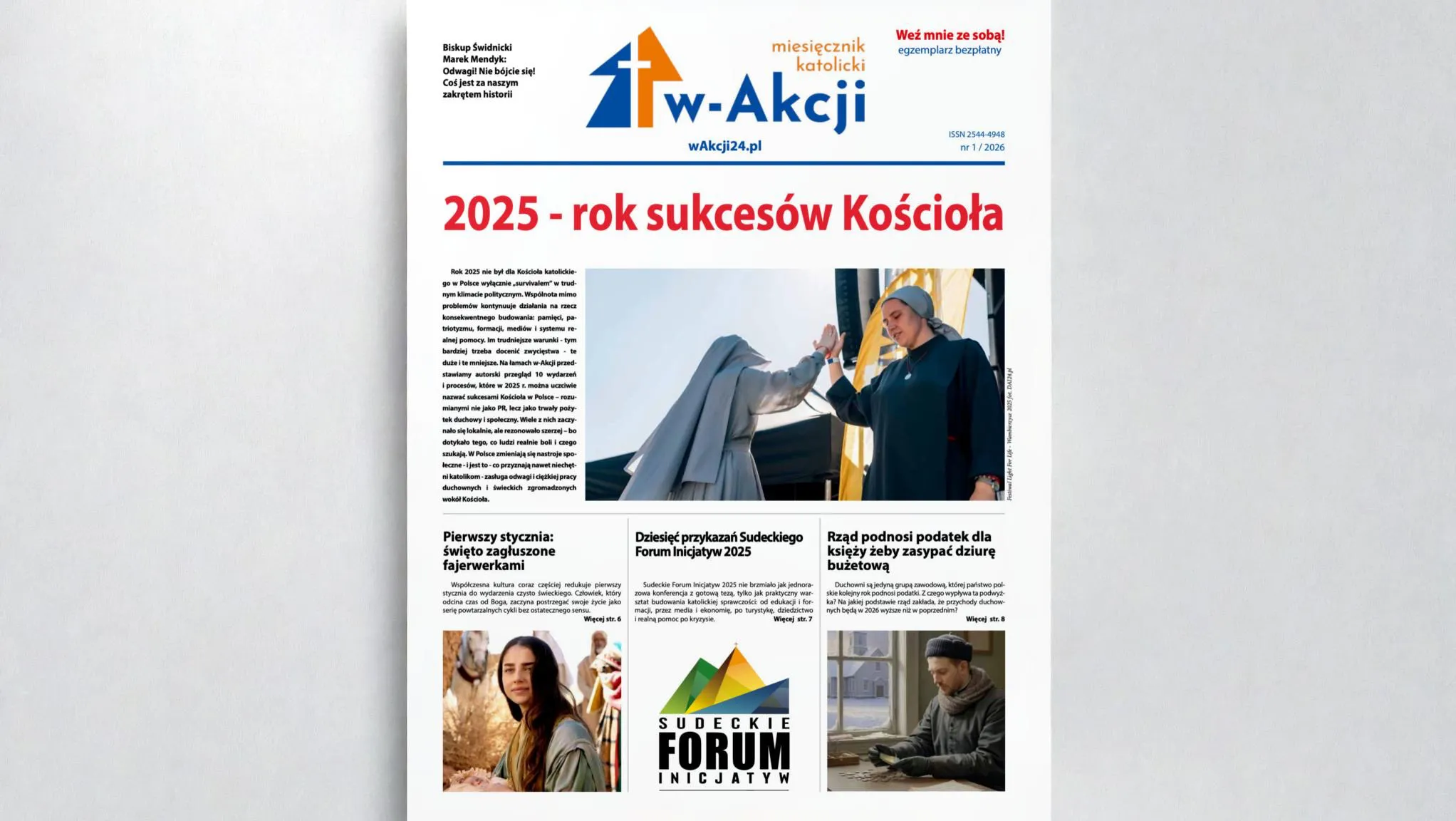
The first 2026 issue of w-Akcji—a free Catholic monthly published in Świdnica (print run: 10,000)—arrives with an editorial ambition that’s almost novelistic in scope: to tell a story about Poland at the turn of the year using a distinctly Catholic vocabulary, yet without retreating into purely devotional speech.
What makes this number worth attention—also from outside the magazine’s immediate ecclesial ecosystem—is its hybrid form. It reads like a collage of genres: pastoral reflection and civic commentary; local diocesan chronicle and wide-angle analysis of the economy; symbolic “cultural semiotics” (the EU flag, the Epiphany procession) and concrete, almost service-journalism interventions (help for addiction recovery, a guide to upcoming orthography changes). The result is not only “a Catholic magazine issue,” but a snapshot of a particular Polish sensibility: one that refuses to separate spirituality from politics, memory from economics, and liturgy from the symbolic battles that shape collective imagination.
The Editor’s Frame: “Hope, Responsibility, and Daily Actions”
The opening editorial sets the tone: January, as the editor-in-chief, Fr. Jakub Klimontowski, writes, is a moment for gratitude and direction-setting—an invitation to see 2025 not merely as a year of difficulties but as a time of “quiet, real victories” in spiritual and community life. The issue positions itself explicitly as a forum: “a space for dialogue, reliable information, and courageous witness of faith.”
This framing matters because it clarifies why w-Akcji does not treat public affairs as an optional add-on. In this issue, economics, taxation, European symbolism, education, and media strategy are presented as fields where Catholic identity must become “agency”—a capacity to act, organize, and endure.
A Theology of Beginnings: January 1 Beyond Fireworks
One of the most literary—and arguably most universal—threads in the issue is the attempt to recover the meaning of January 1 from the noise of modern New Year rituals. The article on the “holiday drowned out by fireworks” argues that contemporary culture reduces the day to a secular reset, a mere change of digits, while losing the spiritual dimension of time itself.
The text proposes an alternative interpretive key: the Catholic feast of Mary, Mother of God. Its claim is not sentimental but structural: if time is detached from God, life begins to look like an endless loop without final meaning; if time is returned to God, the “new” becomes more than motivational enthusiasm—it becomes conversion, relationship, orientation.
For a literary readership, what stands out here is the rhetorical strategy: the piece shifts from cultural diagnosis (fireworks, consumerism, media narratives) to metaphysical anthropology (what a human becomes when time is emptied of transcendence). It reads less like a sermon and more like an essay on the poetics of the calendar.
Europe as Symbol: “The Flag of Our Lady”
A striking centerpiece of the issue is its long article on the European flag—presented not as political branding, but as a contested symbol with layered meanings. The text emphasizes that the flag did not originate in the EU but in the Council of Europe, adopted in 1955 and only later taken up by European Community institutions.
Then the article pivots—almost like a detective narrative—toward Arsène Heitz, a designer associated with early proposals, and argues (with references to archival and journalistic accounts) that Marian imagery shaped the flag’s iconography: twelve stars on blue, echoing the “woman clothed with the sun” motif from Revelation and Marian artistic tradition. The piece includes an especially provocative line attributed to Heitz: “The flag of Europe is the flag of Our Lady.”
But the most revealing element is not the claim itself—it’s the tension the article insists on: between a creator’s religious imagination and secular institutions’ official insistence on non-religious meaning. The magazine treats this as a miniature drama of modern Europe: a civilization built from Christian codes that now often tries to forget its own grammar.
There is also a moral twist: the article warns Catholic readers against burning EU flags in protest, arguing that even if one strongly criticizes EU policy, the symbol’s Marian associations should restrain such gestures. In other words, w-Akcjireframes a contemporary political object as a theological and cultural artifact—and asks readers to behave accordingly.
The Church and the State: Taxation as Theatre
The issue’s most explicitly political-economic intervention is its critique of the clergy “lump-sum” tax increase starting in 2026. The argument is built around a charge of performativity: the tax change is presented as “theatre,” a symbolic gesture meant to produce headlines that “priests pay more,” rather than a reform rooted in data or coherent fiscal logic.
Several points stand out:
- the system is described as archaic because it taxes clergy not on actual income but via categories tied to parish population (and, as the text stresses, even the number of residents in the area, not actual practicing parishioners);
- the increase is criticized for lacking publicly available economic analysis—no transparent numbers, no assessment of parish capacity, no modeling of consequences for charitable spending or upkeep;
- the change is framed as politically convenient because it can be introduced by ministerial regulation rather than a full parliamentary legislative process.
The article also notes an even broader idea circulating in public debate: an “8% faith tax” (a levy on believers’ income directed to churches), mentioned as appearing in a Senate petition—treated here as a sign of how detached the debate can become from lived realities.
For a literary-cultural reader, this section is important not only for its content but for its tone: it blends polemic with institutional self-defense, and it portrays the Church not as an abstract moral voice but as a social body with budgets, buildings, heating bills, and local responsibilities.
Economy 2025: Warning, Fragments of Hope, and a Labour Echo
The economic review by Jerzy Mosoń widens the lens: 2025 is framed as a warning signal for Poland’s development, citing foreign capital outflow and painful bankruptcies, while still pointing to a few developments that “may inspire hope.”
Among the concrete examples included is the post-Rafako industrial transition: the Raciborska Fabryka Komponentów is described as emerging “on the ashes” of the collapsed Rafako plant, with a shift toward defense-industry production and employment plans exceeding 500 jobs—yet also with the caveat that such a pivot does not replace all the lost capacities and industrial ecosystems. The piece also notes a renewed cycle of interest-rate cuts by Poland’s Monetary Policy Council, with the reference rate described as falling to 4% by year’s end, lowering credit costs.
The issue places this economic narrative beside a social one: “Solidarity announces preparations for a nationwide strike,” evoking historical memory and asking whether Poland is approaching another moment of mass protest—while acknowledging that circumstances and scale differ dramatically from 1980.
This juxtaposition—macroeconomics with collective memory—is a recurring w-Akcji technique: it treats economics not as a specialist domain but as a moral and communal environment, shaping families, municipalities, and Church life.
“Ten Commandments” of Catholic Agency: Sudeckie Forum Inicjatyw
Perhaps the most programmatic content comes from the coverage of Sudeckie Forum Inicjatyw (SFI) 2025, described as a practical workshop in building “Catholic agency,” spanning education, media, economics, tourism, heritage, and crisis assistance.
The “ten commandments” format is clever: it translates conference conclusions into memorable imperatives. Among the highlighted themes:
- defending the role of family in education (“children are not state-owned”);
- building a dense network of Catholic schooling and well-supported Catholic homeschooling alternatives;
- entering politics without losing conscience, as service rather than tribal war;
- treating heritage not only as a cost but as a living engine of culture, tourism, jobs, and spiritual encounter;
- creating an “ecosystem of Catholic enterprises” to avoid indirectly financing hostile ideologies—an argument for economic solidarity framed as ethical maturity rather than “commercialization of faith.”
The forum itself is also presented as a narrative of decentralization: a “wandering” format across multiple towns in the Diocese of Świdnica, positioned as one of the few Church-run events in Poland with an explicitly socio-economic profile—boldly compared to a kind of “Catholic Davos.”
From a literary point of view, this is w-Akcji at its most utopian (in the serious sense): not fantasizing, but laying out a blueprint for community power—education, media, business, pilgrimage, culture—as interlocking systems rather than isolated pious acts.
Epiphany in the Streets: The Polish Phenomenon of the Three Kings Procession
The issue’s Epiphany coverage turns public ritual into cultural analysis. The Orszak Trzech Króli is described as taking place in hundreds of towns, with a 2025 reference point of 905 localities and around two million participants nationwide, plus international processions across continents. The article notes that the modern phenomenon began in Poland in 2009 (Warsaw), framing it as a grassroots effort to restore Epiphany’s public character.
What’s most interesting here is the attention to dramaturgy: angels and devils, Herod’s court as a scene of pride and power, shepherds as spontaneous humility, and the Magi as intentional worship—an enacted spectrum of human responses to the divine. The procession becomes, in effect, a popular theatre of moral anthropology.
Gold, Frankincense, and Myrrh: When Symbol Becomes Material
A companion piece asks an unexpectedly modern question: what were the gifts of the Magi worth—materially, not only symbolically? It argues that “the Magi did not bring souvenirs; they brought capital,” and estimates potential quantities and contemporary equivalents (for example, 100 grams of gold at roughly 30–35 thousand PLN, with other ranges discussed).
This is not mere curiosity. The article uses the materiality of the gifts to make a moral claim about providence: God’s care often works through human freedom and generosity, and “real, material support” is one of faith’s concrete tests.
It’s a characteristic w-Akcji move: to pull theology down from abstraction into economics, budgets, and responsibility—without letting it collapse into utilitarianism.
Pastoral Voices and Political Memory: Courage After the “Bend in History”
The issue also carries a condensed homily by Bishop Marek Mendyk, delivered on the 44th anniversary of martial law (13 December 2025). It speaks of waiting and hope—“something is beyond our bend in history,” a line that reads like an epigraph for the whole issue.
Elsewhere, the magazine’s tone hardens into historical accusation: one text asks whether the crime of martial law will remain unpunished—linking remembrance to frustration at a perceived failure of justice and public narrative.
A further pastoral intervention comes through Bishop Ignacy’s message “Do not kneel before Herods,” using the Magi story to insist that God must be sought—cannot be purchased, cannot be acquired by connections—because there is “no shop where you can buy God.” The rhetoric is both spiritual and political: “Herod” functions as a template for any power demanding worship, conformity, or fear.
The Issue’s Practical Register: Recovery, Language, and the Fight for Meaning
w-Akcji also devotes space to pastoral and cultural “care work”:
- A piece addressed to those struggling with alcohol emphasizes prayer and Scripture as supports, but also directs readers to concrete help: AA meetings (aa.org.pl) and local abstinence clubs, including specific phone contacts in Świebodzice and Strzegom.
- A long language-focused article begins with orthography (eleven new rules effective 1 January 2026) but expands into a broader warning about “words washed of meaning” and the political-social consequences of redefining language until a society no longer understands itself. It even lists examples of rule changes, such as capitalization for inhabitants’ names (Warszawianin), and the separated spelling of “czy by.”
For a literary portal, this language essay may be one of the most resonant pieces: it treats linguistic reform not only as a technical update but as a battlefield where reality itself can be clarified—or obscured.
A Catholic Magazine as a Cultural Form
Taken together, w-Akcji No. 1/2026 is not “one message” but a curated polyphony. It argues that Catholic life is not a retreat from modernity, but a way of reading modernity: seeing the EU flag as a contested icon; seeing taxes as symbolic theatre; seeing the economy as a moral environment; seeing public processions as street dramaturgy; seeing language as a struggle for reality; seeing January 1 as either empty repetition or meaningful beginning.
And it ends where it began—with community. The issue highlights recruitment for the evangelizing music project “Sygnał Miłosierdzia,” inviting musicians and choristers to join the 2026 edition (sign-ups listed from 02.01 to 01.02.2026). In the logic of w-Akcji, culture—music included—is not ornament. It is mission, witness, and one more “daily action” in a year that the magazine wants its readers to enter with hope.
The Warsaw Review / KNS / Source: Logos / 11.01.2026